Double Indemnity was not Billy Wilder’s first directorial effort. But, as far as history is concerned, it is his first great directorial effort. And, it was the first of many. Continue reading
Category Archives: Reviews
The Maltese Falcon (1941)
“The cheaper the crook, the gaudier the patter.”—Sam Spade, The Maltese Falcon
It is a recipe for disaster in the world of film noir to be incapable of formulating a good, old-fashioned threat. Continue reading
The Roaring Twenties (1939)*

*or, My Introduction to Film Noir
*or, An Introduction to the Superlative Star-Power of THE James Cagney (a Man Without Peer)
Well, at long last, we’ve reached the end of this fun and fantastic foray into the thrilling theatrical watershed, 1939. The year of such great films as Stagecoach, Gone With the Wind, The Wizard of Oz, Mr. Smith Goes to Washington, Wuthering Heights, Ninotchka, and Midnight, 1939 has long been considered the finest year in Hollywood history. Surely, it is a testament to the era of Great American Screenplays in which it was born. One way in which this era of the great screenplays in American history was characterized was by the star-power it conceived. And, in The Roaring Twenties, we see exactly what sort of star-power the era could produce. Continue reading
The Wizard of Oz (1939)

“If I ever go looking for my heart’s desire again, I won’t look any further than my own back yard. Because if it isn’t there, I never really lost it to begin with! Is that right?”
There is the learning of Dorothy Gale, one of cinema’s most enduring heroines, as she, with her friends, receives her gift from the Wonderful Wizard of Oz. Continue reading
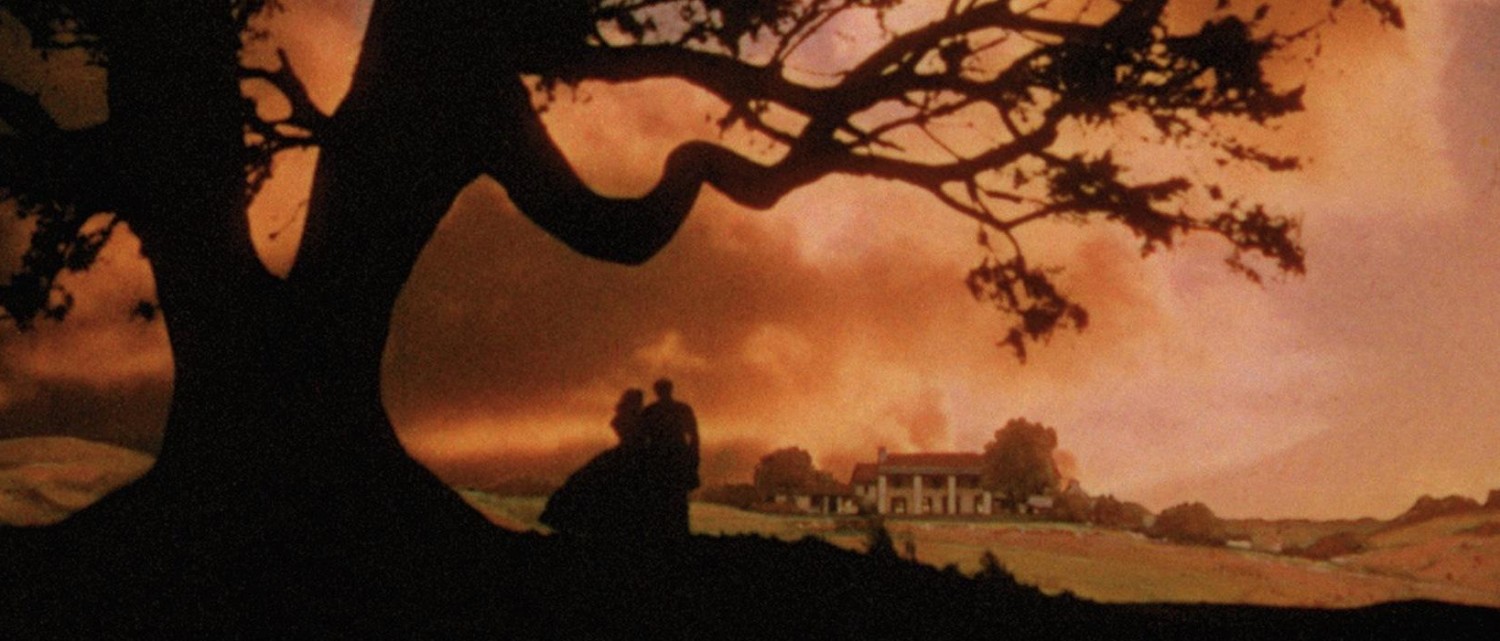
Gone With the Wind (1939)

Let’s face it. We live in an era where the mainstream is something to be feared, and to like the blockbuster is to admit to being the very same “non-person” we all fear becoming. It’s important to look smart and cultured, and so we can’t admit to anything that makes us look too sheltered or nationalistic. We embrace uniqueness or obscurity because it makes us feel like modern day Columbuses…no, strike that. Columbus is too politically incorrect. Continue reading
Wuthering Heights (1939)

One of the great things about studying 1939 is seeing how such a vast enterprise as Hollywood can, at times, seem so small. I feel like I did a pretty good job showing how interconnected the industry was that year in my initial essay on 1939, and how that interconnectedness made Hollywood more a machine than a business. It pumped out films at a tremendous rate—good ones, too. Well, the smallness of Hollywood was at play in the creation of some of 1939’s finest films. Continue reading
Ninotchka (1939)

“This picture takes place in Paris, in those wonderful days when a siren was a brunette and not an alarm—and if a Frenchman turned out the light it was not on account of an air raid!”
So begins the riotous story of Ninotchka and Leon in Paris, penned by Billy Wilder and Charles Brackett. Continue reading
Midnight (1939)

What happens at the stroke of midnight? What happens when those bells chime twelve times through the darkness of a Europe night?
The shining dress turns to rags, the horses are once again house mice, and the carriage transforms back to a simple pumpkin. And the true identity of beautiful Cinderella is made known. Continue reading
Mr. Smith Goes to Washington (1939)

After the bombing of Pearl Harbor in 1941 and the subsequent entry into World War II by the United States of America, James Maitland Stewart joined the US Air Corps. Before the war, Stewart was a talented pilot in the private sector, amassing hundreds of hours of flight time and even participating in a cross-country race as a co-pilot. He had invested (and recruited more investments) in a pilot-training program hosted by Southwest Airways. He was an immensely popular actor on the home-front, starring in such films as The Philadelphia Story with Katharine Hepburn and You Can’t Take it With You with Jean Arthur. He was well-publicized, well-known, and was an interesting character, who loved flying, loved his country, and respected his family’s military tradition. Continue reading
Raise the Red Lantern (1991)
This is a movie with a simple plot, if you can call it a “plot”. It’s more of an examination, a look-in on the life of an interesting and sad character. This is a movie about a woman named Songlian, who is sent to an early twentieth-century harem to be a concubine to the rich landlord. It’s simple enough. There’s no real plot in terms of beginning, middle, and end. It is mostly a documentary of her life—and her decline—as she struggles with the hostility of such an objectified existence. Continue reading
 A Slice of Cake